
Equity Compensation Planning for Startup Employees
A comprehensive guide for startup employees on navigating ISOs, NSOs, RSUs, AMT, and concentration risk to build and protect wealth. Updated August 2026 with current IRS figures, a 2026 AMT phase-out comparison, and Carta private-market liquidity data.
In this article
Navigating the Wealth: Equity Compensation Planning for Startup Employees
Joining a startup is an exciting venture. Beyond the mission and the fast-paced culture, one of the most compelling aspects of startup employment is equity compensation. Whether you are an early-stage employee or joining a late-stage scale-up, equity represents a unique vehicle for building life-changing wealth, particularly for software engineers and other tech professionals whose compensation is often weighted toward company stock.
However, startup equity is also notoriously complex. Between ISOs, NSOs, RSUs, AMT, 83(b) elections, and liquidity constraints, it is easy to make costly mistakes that can erode your hard-earned gains.
At United Financial Planning Group, we specialize in integrating tax planning, investment management, and equity compensation planning for startup employees under one roof. Here is our comprehensive guide on how startup employees can navigate their equity compensation to build and protect their wealth.
1. Understand Your Equity Type
The first step in equity compensation planning is knowing exactly what you hold. Startups generally grant equity in one of three forms:
A. Incentive Stock Options (ISOs)
ISOs are highly tax-advantaged but come with strict regulatory rules.
- The Benefit: If you hold the shares for at least two years from the grant date and one year from the exercise date (known as a Qualifying Disposition), your gains are taxed at the lower Long-Term Capital Gains rate rather than your ordinary income tax rate.
- The Pitfall: When you exercise ISOs, the spread between the fair market value (the 409A valuation) and your strike price is treated as income for Alternative Minimum Tax (AMT) purposes. This can trigger a massive tax bill before you can actually sell your shares for cash.
B. Non-Qualified Stock Options (NSOs)
NSOs are simpler than ISOs but are taxed more aggressively.
- The Benefit: No AMT calculation is required.
- The Pitfall: When you exercise NSOs, the spread is immediately taxed as ordinary income, and your employer is required to withhold taxes (which may or may not cover your actual liability). Any subsequent growth is taxed as capital gains when you sell.
C. Restricted Stock Units (RSUs)
Typically awarded by later-stage startups, RSUs are a promise to deliver shares once certain vesting conditions are met.
- The Double-Trigger Pitfall: Many private startups use “double-trigger” RSUs. They vest only after you meet a time-based condition and the company goes through a liquidity event (like an IPO or acquisition). When that event occurs, all of your accumulated RSUs vest at once, potentially pushing you into the highest income tax bracket overnight.
ISO vs. NSO vs. RSU: Quick Comparison
The three grant types look similar on paper but have meaningfully different tax consequences. The table below summarizes the key distinctions at a glance.
| Feature | ISO | NSO | RSU |
|---|---|---|---|
| Tax trigger point | At sale of shares (ordinary income only if disqualifying disposition; LTCG on qualifying disposition) | At exercise: spread taxed as ordinary income immediately | At vesting: full fair market value taxed as ordinary income |
| AMT exposure | Yes: ISO spread at exercise is an AMT preference item | No AMT preference item on exercise | No AMT preference item; taxed as ordinary income at vesting |
| Employer withholding at exercise/vesting | No required withholding at exercise (AMT must be managed by employee) | Employer withholds on the spread at exercise (may not cover full liability) | Employer withholds on fair market value at vesting (share-withholding or cash common) |
| Typical holding-period consideration | Must hold >2 years from grant, >1 year from exercise for qualifying disposition and LTCG rates; AMT timing makes multi-year modeling essential | Holding period for LTCG starts at exercise; no qualifying-disposition rules apply | Holding period for LTCG starts at vesting; no special holding-period requirement for favorable rate beyond standard one-year LTCG rule |
2. Key Strategies for Private Startup Equity
To maximize your wealth, you must proactively manage your equity before, during, and after vesting.
The 83(b) Election (For Early-Stage Grants)
If you receive stock options or restricted stock at a very early stage (when the 409A valuation is close to zero), you can file an 83(b) election with the IRS within 30 days of the grant.
- This election allows you to pay taxes on the current value of the stock today (which is minimal) rather than when it vests in the future. All future growth is then taxed as capital gains.
- Warning: If the startup fails, you cannot recover the taxes paid upfront. It is a calculated risk that requires expert guidance.
The Exercise Strategy: Cash Flow and AMT Planning
Exercising stock options requires cash: both to pay the strike price and to cover potential tax liabilities (especially AMT for ISOs).
- Early Exercise: Some startups allow you to exercise options before they vest. If paired with an 83(b) election, this can dramatically reduce your tax burden.
- Vesting Schedule Alignment: We help clients map out their exercise schedule to spread out AMT liability across multiple tax years, avoiding a single, overwhelming tax event.
2026 Numbers That Matter for Your Options
The AMT thresholds and capital gains brackets that govern ISO planning are adjusted each year. The table below shows the figures in effect for tax year 2026, including the phase-out change introduced by the One Big Beautiful Bill Act.
| Item | Single / Head of Household | Married Filing Jointly |
|---|---|---|
| AMT exemption amount | $90,100 | $140,200 |
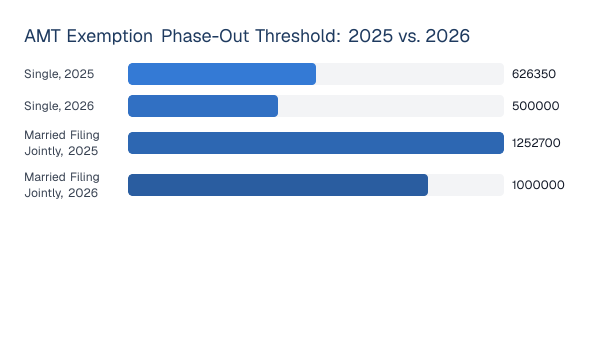
| AMT exemption phase-out begins | $500,000 | $1,000,000 |
| AMT phase-out rate | $0.50 of exemption lost per $1.00 of AMTI above the threshold (i.e., exemption is reduced by 50 cents for each dollar over the threshold, up from 25 cents under prior law) | |
| 0% long-term capital gains rate (up to) | $49,450 taxable income | $98,900 taxable income |
| 15% long-term capital gains rate (up to) | $545,500 taxable income | $613,700 taxable income |
| 20% long-term capital gains rate | Above the 15% thresholds listed above | |
Source: IRS Revenue Procedure 2025-32, released October 2025, for tax year 2026 (irs.gov/newsroom/irs-releases-tax-inflation-adjustments-for-tax-year-2026-including-amendments-from-the-one-big-beautiful-bill). As of August 2026.
Why the Phase-Out Change Matters: A Hypothetical Example
The One Big Beautiful Bill Act reset the 2026 AMT phase-out threshold to $500,000 (single) and $1,000,000 (married filing jointly). That is a meaningful decrease from the 2025 thresholds, which stood at $626,350 (single) and $1,252,700 (MFJ). The practical consequence: a higher-income ISO exerciser who modeled their AMT exposure using 2025 rules could now face AMT they did not anticipate under 2026 rules.
Hypothetical example (for illustration only; does not represent any real client, company, or security): Suppose a single filer earned $300,000 in W-2 income in 2026 and exercised ISOs with a spread of $400,000 (the difference between the 409A fair market value and their strike price at exercise). Their Alternative Minimum Taxable Income (AMTI) is approximately $700,000. Under 2025 phase-out rules, the $626,350 threshold would have allowed a partial exemption that significantly reduced the AMT base. Under the 2026 threshold of $500,000, the phase-out begins about $126,000 earlier, and each dollar above that threshold now erodes twice as much of the exemption (50 cents vs. 25 cents previously), so more of the $90,100 exemption is eroded before the AMT calculation even starts. The result: this individual could owe several thousand dollars more in AMT in 2026 than a mechanical application of 2025 figures would have predicted. Every dollar of ISO spread exercised above the phase-out threshold now carries more AMT weight than it did last year.
This is exactly the kind of multi-year exercise timing analysis that our team of CFP® professionals, CPAs, and Enrolled Agents helps clients model at United Financial Planning Group. Knowing the 2026 numbers before you exercise, not after, is what allows you to sequence grants across tax years, manage the AMT credit carryforward, and avoid a surprise tax bill. Our fee-only fiduciary structure means we do this analysis in your interest, with no commissions or product sales in the picture.
3. Mitigating the “Concentrated Position” Risk
One of the biggest financial planning challenges for startup employees is concentration risk. It is easy to become emotionally attached to the company you are helping to build, but having 50%, 80%, or even 100% of your net worth tied up in a single, illiquid stock is dangerous.
If the company thrives, you win big. But if the company struggles or fails, you lose both your primary income source and your investment portfolio.
The 10% Rule of Thumb
As a general rule, we advise clients to limit their exposure to any single stock to no more than 10% to 15% of their total net worth. Once your startup stock vests and has liquidity, implementing a disciplined, automated sell-off strategy (such as a 10b5-1 plan for executives) allows you to systematically diversify your wealth into a balanced, institutional-grade investment portfolio.
The 2025 Private Market Reality: Tender Offers, Not IPOs
For most startup employees, the realistic path to liquidity in 2025 and into 2026 has been the tender offer, not the IPO. Carta data from its State of Private Markets: Q1 2026 report shows that tender offer volume on the Carta platform reached 396 transactions in 2025, up 62% year over year. (Carta, State of Private Markets: Q1 2026. As of August 2026.) Secondary tender offers have become the dominant liquidity mechanism for employees at late-stage private companies, providing partial liquidity before any public event arrives.
The IPO market is reopening selectively, but it remains narrow. Carta reported 34 IPOs priced in Q1 2026, raising $9.9 billion, concentrated in fintech, AI, and cybersecurity. (Carta, State of Private Markets: Q1 2026. As of August 2026.) That pace is far from the broad IPO windows of prior cycles. The practical implication for most startup employees: plan for years of illiquidity rather than assuming a near-term public event. Concentration risk is not a temporary condition waiting to be resolved at IPO; it is the baseline planning environment you need to manage around now. Tender offers, secondary transactions, and systematic post-vest diversification should all be on the planning calendar before an IPO ever materializes.
This is the exact position many employees at large, late-stage private companies find themselves in. We work with Databricks employees, for example, who hold double-trigger RSUs and ISOs that carry real value on paper but limited liquidity until a tender offer window opens or an IPO occurs.
4. How We Help: The United Financial Advantage
Many financial advisors only look at your investments. Many tax professionals only look at your tax return.
At United Financial Planning Group, we believe that equity planning cannot be done in a vacuum. By bringing tax planning, investment management, and equity compensation under one roof, we provide an integrated strategy:
- Tax Projection Modeling: We simulate ISO exercise scenarios to calculate your exact AMT exposure and determine the most cash-flow-efficient times to exercise, using the current year's thresholds including the 2026 phase-out change.
- Liquidity Planning: We help you prepare for lock-up periods, evaluate tender offer opportunities, and execute post-IPO diversification plans.
- W-2 and Equity Optimization: We ensure your salary, bonus, and equity are fully optimized for your long-term personal wealth goals.
Ready to Optimize Your Startup Equity?
Whether you hold ISOs, NSOs, or RSUs, a proactive plan is the difference between a manageable tax outcome and an unexpected bill. The 2026 AMT phase-out change, ongoing private market illiquidity, and the complexity of multi-year exercise timing all underscore why coordinated, current-year planning matters.
Schedule a complimentary equity consultation with our team today.
Disclaimer: United Financial Planning Group is a registered investment advisor. This material is for educational purposes and does not constitute personalized tax or investment advice. The hypothetical examples in this article are for illustrative purposes only and do not represent any actual client, company, or security. Tax laws are complex, change frequently, and may not apply to your specific situation. Consult a qualified tax professional regarding your individual circumstances.
Talk it through
Want a second set of eyes on your situation?
Schedule a complimentary conversation with our team of CFP ® professionals, CPAs, and Enrolled Agents. No obligation, no sales pitch, just a calm look at how recession risk fits into your specific plan.